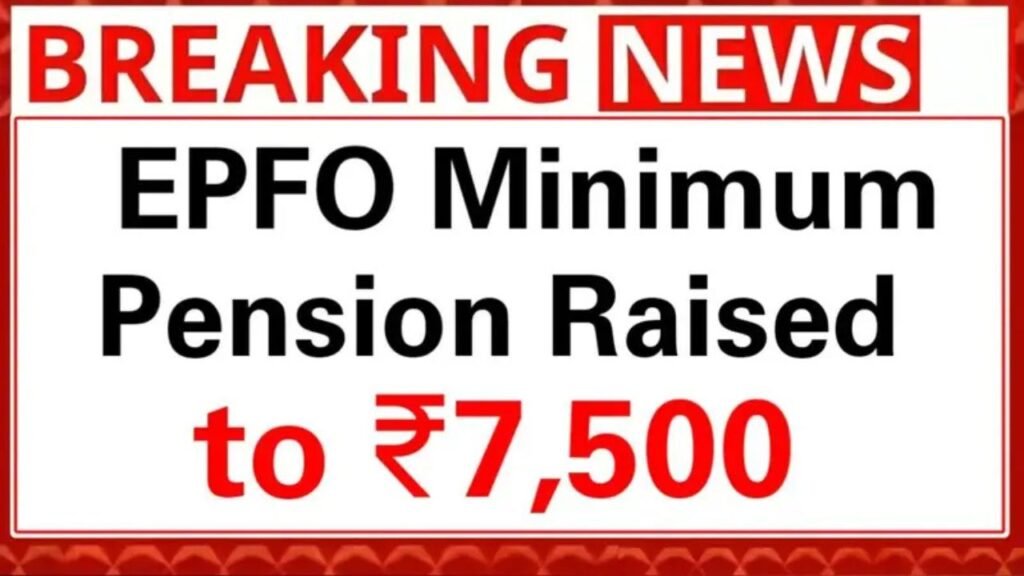
EPFO Pension Revision 2026 : For the millions of Indian workers who look to the Employees’ Provident Fund Organisation (EPFO) for their future security, the horizon appears brighter. Recent discussions and proposals for the Employees’ Pension Scheme (EPS) in 2026 hint at transformative changes designed to redefine retirement living. This isn’t just about adjusting numbers; it’s about reimagining the very fabric of post-retirement life for a vast section of the nation’s workforce. The proposals aim to bridge the gap between a meager existence and a life of comfort and autonomy in one’s golden years.
Elevating the Base of Financial Security
The cornerstone of the proposed revisions is a fundamental shift in the minimum pension guarantee. For an extended period, pensioners receiving the base amount have navigated a difficult economic landscape with a sum that has lost its purchasing power. The proposed increase to a monthly minimum of ₹7,500 marks a pivotal change. For a retiree, this enhanced stability could translate directly into tangible improvements: reliable access to healthcare, the ability to maintain a household without persistent anxiety, and the freedom to engage more fully with family and community. It acknowledges that a life of contribution to the economy deserves a retirement defined by dignity, not daily financial struggle.
Adapting to Modern Earnings for Future Stability
Simultaneously, the proposals look forward by targeting the structural framework of the scheme itself. The “wage ceiling”—the cap on salary used to calculate pension contributions—is a critical component. Currently set at a level that no longer reflects the earnings of many modern professionals, raising this ceiling is essential. This change would allow current employees to have their contributions calculated on a more accurate portion of their salary. Over a career spanning decades, this recalibration can significantly amplify the final pension corpus. It ensures that the pension scheme evolves in step with the economy, providing future retirees with a nest egg that genuinely reflects their working-life earnings.

Here is a summary of the proposed shifts and their intended outcomes:
| Feature | Existing Framework | Proposed Revision (2026) | Foreseeable Impact on Beneficiaries |
|---|---|---|---|
| Guaranteed Minimum Pension | ₹1,000 per month | ₹7,500 per month | Provides a livable income, ensuring basic needs and reducing financial stress for current retirees. |
| Salary Cap for Contributions | ₹15,000 per month | Anticipated to be increased | Enables higher earners to build a substantially larger pension fund, leading to greater post-retirement income. |
| Target Beneficiary Group | Current EPS Pensioners | Current Employees & Future Retirees | Creates a more equitable system that supports today’s pensioners while investing in the future security of the current workforce. |
| Core Objective | To provide a foundational safety net | To ensure comprehensive financial well-being | Aims to align retirement benefits with contemporary economic conditions, fostering genuine financial peace of mind. |
Balancing Aspiration with Long-Term Viability
Any discussion of such significant enhancements naturally invites questions about fiscal prudence and sustainability. Funding a substantial increase in pensions requires a robust and well-considered financial strategy. However, the very presence of this proposal in public discourse signals a positive recognition of a critical social need. It reflects a commitment to modernizing social safety nets to ensure they remain relevant and effective. Viewing this as an investment in the nation’s retirees—who are also its former workers and contributors—is a perspective that enriches the entire social fabric.
A Look Ahead with Informed Hope
The proposed revisions to the EPFO pension for 2026 represent more than just policy adjustments; they represent a promise of a more secure and respectful retirement. By tackling the urgent need for a higher minimum pension and laying the groundwork for a more robust system for future generations, these changes could mark a significant milestone in India’s social security landscape. As the details move from proposal to potential policy, the direction is clear: a concerted effort to ensure that retirement is indeed a time to reap the rewards of a lifetime of hard work.

Frequently Asked Questions (FAQ)
1. Has the ₹7,500 minimum pension been finalized?
No, it is currently a prominent proposal under consideration. While it reflects strong demand and active discussion, it will only become official after a formal notification and approval from the government. It is best to follow official EPFO announcements for confirmation.
2. How exactly does the ‘wage ceiling’ affect my pension?
Your pension contribution is a percentage of your salary, but only up to the wage ceiling. For example, if you earn ₹30,000 but the ceiling is ₹15,000, your pension is calculated on ₹15,000. If the ceiling is raised, your contributions and, consequently, your final pension will be calculated on a higher salary amount, leading to a larger monthly payout after retirement.
3. Who is eligible to benefit from these proposed changes?
The benefits are twofold. Current pensioners receiving the minimum pension would see an immediate increase in their monthly amount. Employees who are still working and contributing to the EPS would benefit from the higher wage ceiling, allowing them to accumulate a larger pension corpus for their own retirement.

4. When could these new rules potentially be implemented?
The proposal is targeted for the year 2026. An exact implementation date has not been set and will be announced by the EPFO and the central government. For the most reliable and current information, always refer to the official EPFO website.